
Why Is My Car Overheating? Common Causes and Fixes
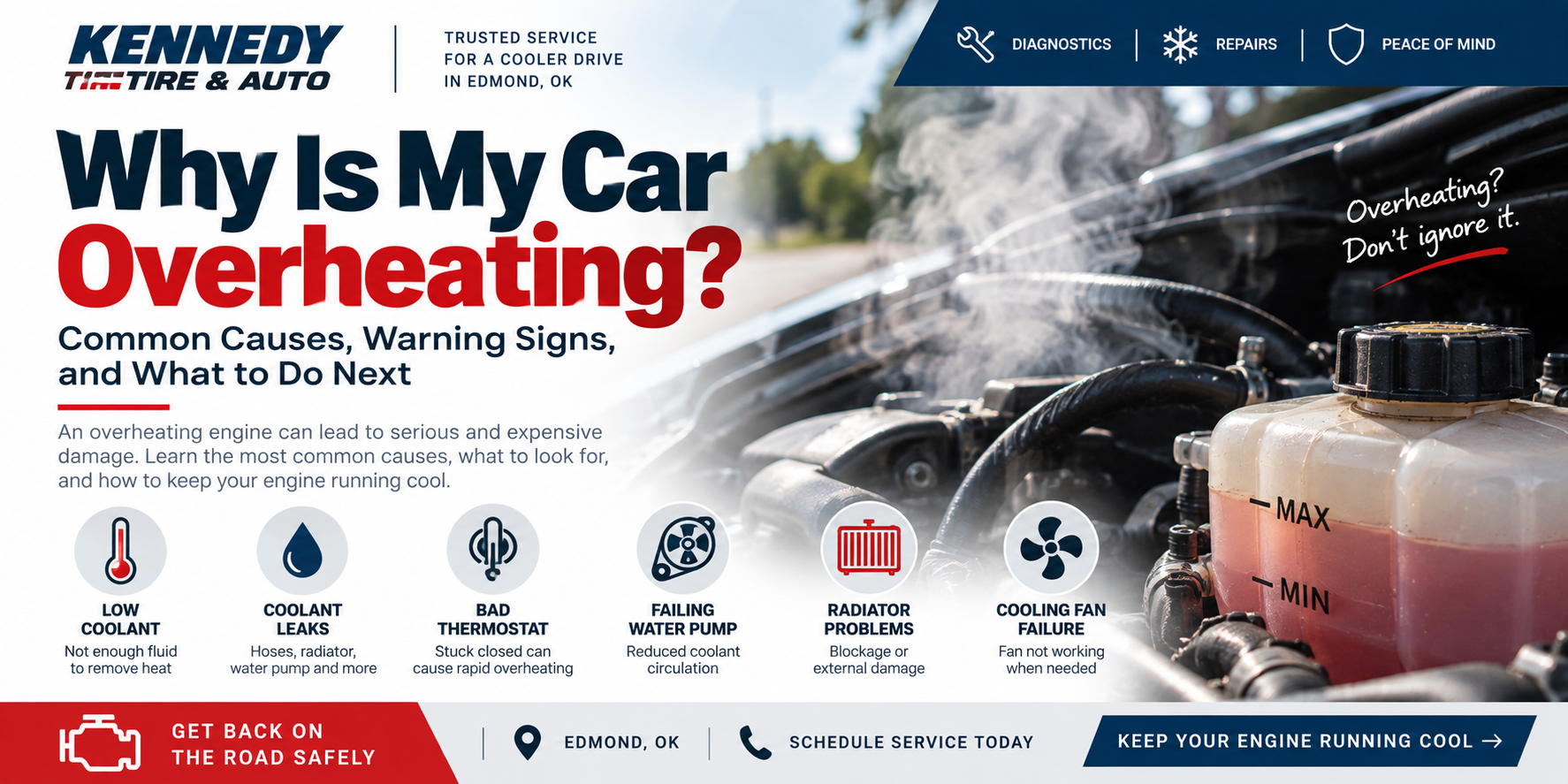
A car overheats when the engine produces more heat than the cooling system can remove. The most common causes are low coolant, coolant leaks, a failed thermostat, radiator problems, a bad water pump, cooling fan failure, or loss of cooling-system pressure.
An overheating engine should never be ignored. Excessive heat can damage cylinder heads, head gaskets, pistons, bearings, seals, and other internal engine components. What begins as a leaking hose or failed thermostat can become a much more expensive engine repair if the vehicle is driven while overheating.
Kennedy Tire & Auto provides cooling system repair in Edmond, OK, for overheating, coolant leaks, water pump problems, thermostat failures, and other cooling system concerns.
Why Does a Car Overheat?
A car overheats when the coolant cannot absorb, circulate, or release engine heat effectively.
Combustion produces tremendous heat inside the engine. Coolant absorbs part of that heat, the water pump circulates it through the engine, and the radiator transfers it to the outside air.
The thermostat regulates coolant flow, cooling fans move air across the radiator when necessary, and the radiator cap helps the system maintain the pressure needed to operate at higher temperatures without boiling.
A failure anywhere in that process can cause engine temperature to rise.
1. Low Coolant
Low coolant is one of the most common reasons an engine overheats because there is not enough fluid available to absorb and transport engine heat.
A properly functioning cooling system should not routinely consume large amounts of coolant.
If the reservoir repeatedly becomes low, coolant is probably escaping somewhere or, less commonly, entering the engine internally.
Possible causes include:
- Leaking hoses
- Radiator leaks
- Water pump leaks
- Thermostat housing leaks
- Expansion tank leaks
- Heater core leaks
- Faulty radiator or pressure cap
- Head gasket problems
Adding coolant may temporarily restore normal temperature, but it does not repair the leak that caused the level to fall.
If coolant keeps disappearing, the system should be pressure-tested and inspected.
2. Coolant Leaks
A coolant leak can cause overheating by lowering coolant volume and preventing the system from maintaining proper pressure.
Leaks can occur almost anywhere in the cooling system.
Some are obvious. You may notice coolant dripping beneath the vehicle or see wet residue around a radiator hose.
Others only leak when the engine is hot and the system is pressurized, which can make the source much harder to identify.
Coolant colors vary by vehicle and formulation, so a leak is not always bright green. Depending on the coolant, it may appear orange, yellow, blue, pink, or another color.
A sweet odor after driving can also indicate that coolant is escaping.
Professional cooling system service can include inspection and pressure testing to locate leaks that are difficult to find visually.
3. Bad Thermostat
A thermostat stuck closed can quickly cause overheating because it prevents hot coolant from circulating from the engine to the radiator.
The thermostat remains closed while the engine warms up, then opens as the operating temperature rises.
If it fails in the closed position, coolant circulation through the radiator may be severely restricted.
Typical symptoms can include:
- Rapid temperature rise
- Overheating shortly after driving begins
- The temperature gauge is suddenly climbing
- Large temperature differences between cooling-system hoses
- Little or no coolant circulation through the radiator
A thermostat can also malfunction intermittently, making the overheating problem appear to come and go.
Replacing a defective thermostat restores normal coolant flow, but technicians should still inspect the rest of the cooling system to ensure that no other condition contributed to the failure.
4. Failing Water Pump
A bad water pump causes overheating when it can no longer circulate enough coolant through the engine and radiator.
The water pump continuously moves coolant through the cooling system while the engine is running.
Water pumps can fail in several ways. The pump bearing can wear out, a seal can begin leaking, or the internal impeller can become damaged or ineffective.
Common symptoms include:
- Coolant leaking near the front or side of the engine
- Grinding or whining noises
- Engine overheating
- Coolant loss
- Steam or high engine temperature
Not every failing water pump leaks externally. An internal impeller problem can reduce coolant circulation without producing an obvious puddle.
Kennedy Tire & Auto’s cooling system repair service includes diagnosing and replacing faulty water pumps and related cooling system components.
5. Radiator Problems
A damaged, leaking, restricted, or internally clogged radiator can cause overheating because it cannot transfer enough heat from the coolant to the outside air.
The radiator is effectively the cooling system’s heat exchanger.
Hot coolant flows through passages inside the radiator while outside air removes heat from the radiator fins.
Several problems can reduce that heat transfer:
- Internal deposits or restrictions
- Damaged cooling fins
- External debris blocking airflow
- Corrosion
- Coolant leaks
- Internal radiator deterioration
If coolant cannot flow through the radiator correctly—or air cannot move through it—the engine may run progressively hotter.
Kennedy Tire & Auto provides dedicated radiator repair and service for leaks, restrictions, coolant problems, and other radiator-related overheating conditions.
6. Cooling Fan Failure
If a car overheats while sitting still but cools down once you start driving, a failed radiator fan or airflow problem is a strong possibility.
At highway speed, forward motion forces a large amount of air through the radiator.
At a stoplight or while idling, that natural airflow disappears. Electric cooling fans must then pull or push air through the radiator.
If a fan motor, fuse, relay, temperature sensor, wiring circuit, or fan-control module fails, the engine may overheat in traffic but operate normally at speed.
This symptom pattern is particularly useful diagnostically:
Overheats at idle but not while driving = inspect radiator airflow and cooling fan operation.
It is not an absolute diagnosis, but it substantially narrows the possibilities.
7. Bad Radiator Cap or Pressure Cap
A faulty cooling-system cap can cause overheating because the system may no longer maintain the pressure required to prevent coolant from boiling at normal operating temperatures.
Cooling systems operate under pressure because increasing pressure raises the coolant’s boiling point.
The cap contains a calibrated pressure valve. If the cap cannot maintain the specified pressure, coolant can boil or escape at a lower temperature than intended.
A bad cap may cause:
- Coolant loss
- Overflow reservoir problems
- Boiling coolant
- Overheating
- Air entering the cooling system
Because the cap is relatively simple, it is easy to overlook during overheating diagnosis.
The correct replacement cap must match the pressure specification required by the vehicle manufacturer.
8. Air Trapped in the Cooling System
Air pockets can interrupt coolant circulation and create localized hot spots, especially after cooling-system service or a coolant leak.
A cooling system is designed to circulate liquid rather than large pockets of air.
After coolant is drained, a component is replaced, or a leak allows air into the system, some vehicles require a specific bleeding or vacuum-filling procedure.
Trapped air may cause:
- Fluctuating temperature readings
- Intermittent overheating
- Poor heater performance
- Gurgling sounds
- Coolant-level changes
Modern cooling systems can be difficult to bleed correctly because thermostats, heater circuits, turbochargers, and multiple cooling loops can trap air.
If overheating begins immediately after cooling-system repairs, trapped air should be considered.
9. Collapsed or Restricted Radiator Hose
A damaged or internally restricted coolant hose can reduce coolant flow to the point that overheating occurs.
Radiator hoses deteriorate with age and repeated heat cycles.
A hose may look acceptable externally while becoming weakened internally.
Some hoses can collapse under suction at higher engine speeds, while others develop internal separation that restricts coolant circulation.
Symptoms may include overheating under load, visible hose deformation, coolant leaks, or unexplained circulation problems.
Hoses should be inspected for swelling, cracking, softness, hardening, leakage, and internal deterioration during cooling-system service.
10. Wrong Coolant or Contaminated Coolant
Incorrect, degraded, or contaminated coolant can reduce cooling-system performance and contribute to corrosion, deposits, and component failure.
Modern vehicles use different coolant chemistries.
Coolants that look similar are not necessarily chemically compatible.
Mixing incompatible formulations can sometimes create deposits or reduce the corrosion protection required by the cooling system.
Coolant also deteriorates over time as its additives are depleted.
Following the manufacturer’s specified coolant type and service interval helps protect the radiator, water pump, heater core, engine passages, and seals.
Kennedy Tire & Auto offers coolant and antifreeze service when old coolant needs replacement or the cooling system requires repair.
11. Head Gasket Failure
A failed head gasket can cause overheating by allowing combustion gases into the cooling system, coolant into the cylinders, or coolant and oil to mix.
The head gasket seals the joint between the engine block and cylinder head.
When the gasket fails, the symptoms depend on where the breach occurs.
Possible signs include:
- Repeated overheating
- Coolant loss with no obvious external leak
- Bubbles or excessive pressure in the cooling system
- White exhaust vapor after warm-up
- Misfires after startup
- Coolant contamination
- Oil contamination in some failures
Importantly, not every head gasket failure produces milky oil, and not every overheated engine has a failed head gasket.
Combustion gas testing, cooling system pressure testing, cylinder leak testing, and other engine diagnostics may be needed to confirm the failure.
12. Engine Problems That Create Excessive Heat
Less commonly, an internal engine or combustion problem can create abnormal heat even when much of the cooling system is functioning correctly.
Serious mechanical problems can increase operating temperatures or make overheating harder to control.
Examples include internal head gasket failure, cylinder head damage, severe combustion problems, restricted coolant passages, or other internal engine conditions.
Repeated severe overheating can also cause the engine problem itself.
Once aluminum cylinder heads become excessively hot, they may warp. Head gaskets can fail, seals can deteriorate, and internal lubrication can suffer.
Kennedy Tire & Auto provides engine repair in Edmond when overheating has progressed beyond an external cooling system problem.
Why Is My Car Overheating but It Has Coolant?
A full coolant reservoir does not prove the cooling system is working. The engine can overheat if coolant is not circulating or releasing heat correctly.
Possible causes include:
- Thermostat stuck closed
- Failed water pump
- Restricted radiator
- Cooling fan failure
- Air trapped in the system
- Head gasket failure
- Collapsed hose
- Incorrect temperature-sensor readings
Coolant level is only one part of the system.
The coolant must circulate through the engine, reach the radiator, transfer its heat, and return to the engine to repeat the cycle.
Why Does My Car Overheat When Idling?
Overheating mainly at idle often indicates insufficient airflow through the radiator, typically due to a cooling fan or fan-control problem.
When the vehicle is moving, air naturally passes through the radiator.
When stopped, the cooling fan becomes responsible for maintaining airflow.
If temperature rises in traffic but falls after the car reaches highway speed, technicians will typically inspect fan operation, relays, fuses, sensors, wiring, and radiator airflow.
Low coolant and radiator restrictions can produce similar symptoms, so the fan should be tested rather than automatically replaced.
Why Does My Car Overheat Only When Driving?
Overheating at speed can indicate restricted coolant flow, a weak water pump, radiator restriction, combustion gas intrusion, or a problem that occurs only under higher engine load.
An engine produces more heat while accelerating, climbing hills, towing, or operating at highway load.
A marginal cooling system may handle idle operation but be unable to remove heat quickly enough under load.
Technicians may investigate coolant circulation, radiator efficiency, thermostat operation, pressure retention, combustion gases, and water-pump performance.
Why Does My Temperature Gauge Go Up and Then Back Down?
Rapid or repeated temperature fluctuations can result from a stuck thermostat, low coolant, trapped air, intermittent fan operation, or inaccurate temperature sensor data.
Small changes in temperature are normal.
Large or repeated swings are not.
A thermostat that sticks closed and suddenly opens can cause the gauge to climb and then fall. Air pockets can also cause the temperature sensor to alternate between coolant and trapped air.
Professional vehicle diagnostics can help determine whether the engine is genuinely overheating or the gauge is receiving inaccurate information.
Can Low Oil Cause a Car to Overheat?
Severely low engine oil can contribute to higher engine temperatures because oil lubricates moving components and carries away some heat, but most overheating problems originate in the cooling system.
Oil reduces friction inside the engine.
If the oil level drops to a critically low level, friction and component temperatures can increase, potentially causing serious engine damage.
However, if the coolant temperature gauge suddenly rises, the first diagnostic focus is generally the cooling system unless there are also signs of low oil pressure.
Never continue driving if the oil-pressure warning remains illuminated while the engine is running.
Can I Drive an Overheating Car?
No. Continuing to drive an overheating engine can turn a relatively inexpensive cooling-system repair into major engine damage.
If the temperature warning appears or the gauge moves into the hot zone:
- Turn off the air conditioning.
- Move safely out of traffic.
- Shut the engine off.
- Allow the engine to cool.
- Do not remove a hot radiator or pressure cap.
A pressurized cooling system can contain coolant at a temperature above its normal atmospheric boiling point. Removing the cap while hot can suddenly release pressure, causing boiling coolant or steam to escape.
If the vehicle repeatedly overheats, it should be diagnosed before normal driving resumes.
What Happens If You Keep Driving an Overheating Car?
Continued overheating can warp cylinder heads, damage the head gasket, reduce oil protection, and ultimately cause catastrophic engine failure.
Engine components are designed to operate within a controlled temperature range.
Extreme heat can cause metal components to expand beyond their intended tolerances.
Possible consequences include:
- Warped cylinder head
- Blown head gasket
- Damaged pistons or cylinders
- Bearing damage
- Oil breakdown
- Cracked engine components
- Complete engine failure
The repair cost can increase dramatically once overheating progresses from a cooling-system fault to internal engine damage.
What Should You Do If Your Car Starts Overheating?
Safely stop the vehicle and shut the engine off before the temperature reaches a level that causes permanent damage.
Do not assume that turning the heater on makes continued driving safe.
Running the heater can sometimes remove a small amount of additional engine heat and may help temporarily while moving out of traffic, but it does not repair the underlying problem.
After the engine has cooled completely, coolant level can be checked according to the vehicle manufacturer’s procedure.
If coolant is missing, leaking rapidly, or the vehicle overheats again after restarting, further driving can damage the engine.
How Is an Overheating Problem Diagnosed?
Overheating diagnosis requires determining whether the problem involves coolant quantity, circulation, pressure, airflow, heat transfer, or excessive engine heat.
Testing may include:
- Cooling system pressure testing
- Coolant level inspection
- Radiator cap testing
- Thermostat testing
- Cooling fan operation
- Water pump inspection
- Radiator temperature measurements
- Leak inspection
- Combustion gas testing
- Computer diagnostics
- Engine mechanical testing
The temperature gauge tells you that something is wrong. It does not identify the failed component.
That is why accurate vehicle diagnostics are important before replacing cooling-system parts.
How Can You Prevent Your Car From Overheating?
Maintaining coolant condition and level and inspecting cooling-system components before they fail are the most effective ways to reduce the risk of overheating.
Follow the manufacturer’s maintenance schedule for coolant replacement and regularly inspect the vehicle for leaks.
Watch for early warning signs such as coolant odor, temperature fluctuations, declining coolant level, visible leaks, or cooling fans that do not operate normally.
Routine vehicle maintenance gives technicians an opportunity to identify deteriorated hoses, low fluid levels, leaks, and other developing problems before they result in an overheated engine.
Cooling System and Overheating Repair in Edmond, OK
If your temperature gauge is climbing, coolant is leaking, the engine overheats in traffic, or the vehicle repeatedly loses coolant, the problem should be diagnosed before it causes engine damage.
Kennedy Tire & Auto provides cooling system repair, radiator repair, vehicle diagnostics, engine repair, and preventative vehicle maintenance for drivers in Edmond and the surrounding Oklahoma City area.
Catching a coolant leak, thermostat problem, weak water pump, or fan failure early is considerably better than allowing repeated overheating to damage the engine.